
If you’ve lived in Wentzville for more than a few years, you’ve seen the growth. New neighborhoods near Pearce Boulevard. Expanding campuses in the Wentzville R-IV School District. Busy sports schedules, school concerts, and packed family calendars. With so much happening, it’s easy to wonder: When is the right time to start thinking about braces?
Many parents ask us at Parkway Family Dental Care what the best age for braces really is. Is there a perfect moment? Is it middle school? High school? Earlier? The truth is: there isn’t one “magic” age that fits every child, but there is a recommended starting line.
In this guide, we’ll walk through what orthodontic experts recommend, what we look for clinically, and how that guidance fits into the real-life schedules of families in Wentzville, Lake St. Louis, O’Fallon, and across St. Charles County. Our goal is simple: give you clarity, not pressure.
Why Orthodontists Recommend an Evaluation at Age 7
When parents search for the best age for braces, they’re usually thinking about when treatment should begin. Orthodontic experts focus first on when evaluation should begin.
The American Association of Orthodontists recommends that children have an orthodontic screening by age 7. This does not mean every 7-year-old needs braces. It means this is the age when we can accurately assess how the teeth and jaws are developing. By age 7:
- The first permanent molars have typically erupted
- The front permanent teeth are coming in
- Jaw growth patterns are easier to measure
- Bite problems such as crossbite or underbite can be identified early
This gives us enough information to determine whether a child will likely need treatment later and whether early intervention would be beneficial. At Parkway Family Dental Care, most age-7 visits result in one of three outcomes:
- No treatment needed: Continue routine dental care
- Growth monitoring: Periodic check-ins to track development
- Early (Phase I) treatment: Recommended only if a specific issue is present
Most children fall into the first two categories. Phase I treatment is limited and targeted. It may involve guiding jaw growth or correcting a developing bite issue while a child is still growing. Full braces, often called Phase II treatment, typically happen later during the pre-teen or early teen years when most permanent teeth are in place.
The reason age 7 matters is simple: some orthodontic problems are easier to correct during growth. Identifying them early gives families more options and better long-term outcomes.
When Braces Happen: What to Expect at Each Stage
The best age for braces depends less on a specific number and more on development. That said, most patients fall into one of three general stages.
Ages 7-9: Early Intervention (When Necessary)
This is the window where we may recommend Phase I treatment, but only if there’s a specific concern. Common reasons for early treatment include:
- Severe crowding
- Crossbites
- Underbites
- Jaw growth discrepancies
- Habits that are affecting bite development
Early treatment at this stage is usually short-term and focused. The goal is not cosmetic alignment. The goal is to guide jaw growth while it’s still flexible.
For many children in Wentzville and nearby communities like Lake St. Louis and Foristell, this stage is simply about monitoring. If development looks healthy, we wait.
Ages 10-14: The Most Common Time for Full Braces
For most families, this is the typical treatment window. By this stage:
- Most permanent teeth have erupted
- The adolescent growth spurt is beginning or underway
- Jaw growth can be directed more efficiently
This is why middle school years, whether your child attends Wentzville Middle School or Frontier Middle, are the most common time to begin comprehensive orthodontic treatment.
Because the body is still growing, tooth movement is generally more efficient during this stage than in adulthood. Treatment timelines are often more predictable as well.
Teens & Adults: It’s Not Too Late
Some families choose to wait. Others move to the area and begin care later. Some teens simply weren’t ready earlier. Orthodontic treatment is still very effective for high school students and adults.
For teens at schools like Liberty High School or Holt High School, discreet options such as clear aligners are often preferred for aesthetic and social reasons. Adults in St. Charles County frequently choose similar options for professional convenience.
The key difference is that growth is complete, so treatment planning focuses entirely on tooth movement rather than jaw development.
The takeaway: Age 7 is the evaluation benchmark. Ages 10–14 are the most common treatment years. But orthodontics can be successful at almost any age with the right plan.
What a Consultation Actually Involves
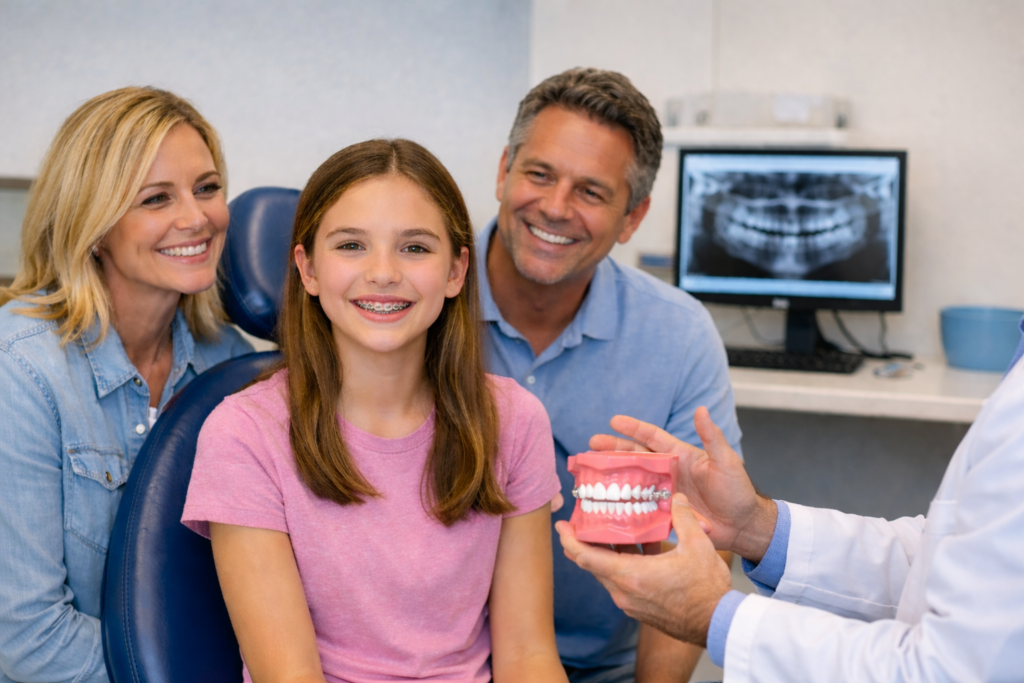
When families visit Parkway Family Dental Care for an orthodontic evaluation, the goal is assessment, not immediate treatment. Many children we see do not start braces right away. If growth and bite development are within normal limits, we place them on a monitoring schedule and reassess periodically.
This observation period is intentional. Starting treatment too early can extend overall time in braces without improving the final result. Proper timing allows us to work with natural growth patterns rather than against them. When early treatment is recommended, it’s because there is a clear clinical reason, such as a developing crossbite, significant crowding, or jaw alignment issue.
We also use digital 3D scanning technology rather than traditional impression trays. This provides accurate imaging of tooth position and jaw structure while improving comfort. Parents can see detailed models of their child’s development, which makes treatment planning more transparent and easier to understand.
Orthodontic treatment is generally most efficient during periods of active growth, particularly between ages 10 and 14. During this time, bone remodeling occurs more readily, and tooth movement is more predictable. Determining the best age for braces is not about choosing a fixed number, it’s about identifying when growth and development make treatment most effective.
What Wentzville Parents Should Consider Before Starting Treatment
For many families, orthodontic decisions are made around real-life commitments like school schedules, sports seasons, and after-school activities. Timing treatment isn’t only about identifying the best age for braces. It’s also about choosing a window that minimizes disruption to your child’s routine.
Students involved in athletics can safely wear braces, but protective equipment becomes essential. A properly fitted mouthguard is especially important for contact sports. For students participating in band or orchestra, there may be a short adjustment period as they adapt to braces while playing instruments. These are manageable changes, but they are worth planning for.
Convenience also plays a role. Routine adjustment visits occur every few weeks during active treatment. Choosing a dental office close to home, particularly near W Pearce Boulevard and central Wentzville neighborhoods, makes appointments easier to manage and reduces missed school time. Families from nearby communities such as Lake St. Louis and O’Fallon often consider proximity when coordinating ongoing care.
Before beginning treatment, most parents think through a few practical questions:
- Is this starting point aligned with school breaks or sports seasons?
- How often will adjustment visits be scheduled?
- What type of mouthguard will be needed for athletics?
- Are there scheduling options that minimize missed class time?
Orthodontic treatment works best when it fits into a family’s routine. Careful planning ensures that when treatment begins, it supports both long-term dental health and day-to-day life in St. Charles County.
The Parent’s Checklist: What to Ask at Your First Visit
Starting orthodontic treatment is a long-term decision. Asking clear, practical questions during your first visit helps you understand timing, expectations, and overall commitment.
1. Does My Child Need Treatment Now or Should We Monitor?
One of the most important questions to ask is whether treatment needs to begin immediately. Many children benefit from a period of growth monitoring rather than starting braces right away. Understanding why treatment is recommended or why it can wait helps you feel confident in the timing. A responsible orthodontic plan should clearly explain what is developing, what risks exist if nothing is done, and whether waiting could affect long-term outcomes.
2. How Long Will Treatment Take?
Orthodontic treatment length varies depending on age, growth stage, and the complexity of the case. For many adolescents, comprehensive treatment lasts between 18 and 24 months, but individual timelines differ. It’s important to understand how frequently adjustment visits will be scheduled and what factors could extend treatment. Clear expectations allow families to plan around school schedules, sports seasons, and other commitments.
3. What Are the Total Costs and Payment Options?
Before beginning treatment, ask for a complete financial overview. This should include total cost, what is covered within that fee, and whether retainers and follow-up visits are included. Many dental insurance plans in Missouri provide orthodontic benefits for children, and financing options are often available to spread payments over time. Transparency in pricing reduces stress and prevents unexpected costs later.
4. What Happens if There’s an Emergency?
Brackets can loosen, wires can shift, and aligners can be misplaced. While most issues are minor, it’s helpful to know how they are handled. Ask what situations require an immediate call and what can be managed at home temporarily. Understanding the office’s response process gives families peace of mind during active treatment.
5. What Treatment Options Are Available?
Traditional metal braces remain highly effective, but they are not the only option. Depending on the clinical needs of your child, alternatives such as clear ceramic braces or aligner systems may be appropriate. The key question to ask is not just what options exist, but which option is best for your child’s specific bite and why. A clear explanation should connect the recommended appliance to the treatment goals.
Schedule Your Child’s Orthodontic Evaluation in Wentzville
If you’re wondering about the best age for braces, the most important step is a professional evaluation. While age 7 is the recommended screening benchmark, treatment timing depends on your child’s individual growth and bite development. At Parkway Family Dental Care, we focus on clear recommendations and responsible timing. Many children we see simply need monitoring, not immediate treatment.
Our dental office in Wentzville is committed to making families feel comfortable and informed at every stage. We provide gentle, personalized services in a welcoming environment designed to put both parents and children at ease. Care is led by Dr. Ryan Winschel, who grew up in the St. Charles County area and remains actively involved in continuing education and professional organizations to ensure patients receive high-quality, up-to-date care.If you’d like clarity about your child’s orthodontic development, we invite you to schedule a no-pressure consultation at our office at 1063 W Pearce Blvd in Wentzville. Call 636-327-6880 to speak with our team and choose a time that fits your family’s schedule.